Tuesday, August 1, 2023

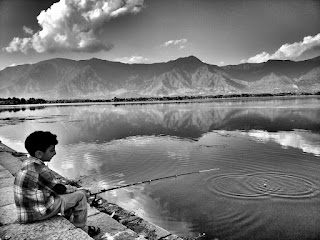
The boy with a fishing rod

On the tranquil banks of Dal, a boy sits all alone,
His fishing rod in hand, his heart a heavy stone.
The waters glisten, memories of happier days,
But now, he longs for parents' love, in a heartfelt craze.

The gentle ripples mock his pain, a whisper on the breeze,
As he casts his line with hope, searching for some ease.
He dreams of days gone by, when laughter filled the air,
With parents by his side, a bond beyond compare.

The fishing rod, a silent plea, a yearning to be near,
For parents' tender love, their voices in his ear.
He gazes at the horizon, where the sun begins to set,
Wishing they were by his side, to comfort and to pet.

Their absence like a void, a puzzle incomplete,
He misses their warm embrace, their laughter oh so sweet.
He casts his line into the lake, a metaphor of his desire,
To reel back the days of joy, with love that will not tire.

The memories come rushing in, like waves upon the shore,
Their love an anchor in his heart, forever to explore.
He holds onto their essence, their love a guiding light,
Through lonely nights and stormy days, he feels their presence bright.

The moon above, a gentle smile, that watches from afar,
As the boy keeps fishing on, beneath the twinkling stars.
He knows that love transcends, time, distance, and space,
And in his heart, his parents' love will forever find its place.

So, the boy keeps fishing on, on the banks of Dal,
With the fishing rod in hand, a love he'll never forsake.
Though he misses their laughter, their love forever lasts,
A bond that time can't sever, as it echoes in his past.

Thursday, August 23, 2018

The Stacks

i read through 
the stacks of bricks..
and wonder about 
the souls it binds..

Saturday, March 18, 2017

The Eternal Lump

The recent image by Javed Dar took me back to my childhood when I attended funerals daily as my maternal home was near the Martyr’s graveyard of Eidgah. There was a day when I attended 12 funerals while we played our cricket match in the adjacent ground. Such cricket matches never reached a conclusive end. At times, we were so exhausted and emotionally drenched that we lost interest in all worldly things and sat on the boundary wall of the graveyard, waiting for the arrival of the unknown guest. 

We all have faced times when feelings started to overflow but somehow halted just below the throat. We pretended to be strong. We acted brave just because we never wished to be called the weak link of the chain that surrounded us and held us strong. We saw our elders holding the fort amidst the crackdown announcements from the masjids. I saw my grandfather standing upfront and not allowing the men in uniform to enter our house where only females were left alone while men were asked to assemble in a play-field for identification parades.
We never got tired while quenching the thirst of innumerable families who waited outside our home that was just adjacent to a security camp. They waited on the roadside, dawn to dusk, to seek the whereabouts of their wards who were picked up from the nearby localities. They mostly returned empty handed to return the next day.
Those sleepless nights when screams of boys filled the dark skies. We heard the cries escaping the walls of those killing rooms inside the camp. Those nights were scary and I hated the sight of the moon.
This image of the boy, Burhan Fayaz crying at the funeral of his friend Amir Nazir of Pulwama, prompts us about the loss, the resentment, imprisonment of soul, the outburst and the resilience. That eternal lump we all have been carrying along since decades. The legacy that we inherited and will further pass on to the next progeny.
Our baton has been our resolve. Our tears have always oiled the wheels of resilience.
We have come across two images of the same boy (Burhan Fayaz), one by Javaid Dar and the other by Waseem Andrabi. These two and many of their colleagues are our messengers. I am proud of our storytellers who are archiving our story for the times to come.

We share the same sky,
the same moon,
the same thunder.
We walk along!
~
Majid
(Illustration: An attempt with Charcoal / Javaid's image)

Tuesday, January 12, 2016

Home

I miss,
that haunting stillness, 
that deafening silence,
my frozen memoir of life,
some call it heaven,
but I call it 'home'....


Saturday, January 2, 2016

Art to wait....


We have mastered 
our ability to wait.. 
Yes, to keep waiting for 
nothing. 
Have seen this trait in rich practice 
back home 
where we are aware 
that they won't return. 
Searching from pillar to post,
from meadows to the quicksand,
from north to south,
tilling the soil, 
looking for the remains
but the wait is on. 
While blending 
our helplessness and agony,
days became months 
and then years, 
and then decades
but the wait is on
endless.. 


Sunday, April 5, 2015

A glimmer of hope

A few days back, battling with the restlessness due to yet another possibility of floods back home in Kashmir, I stepped out and tried to divert myself with a stroll around the lawn. On one of the branches of a tree I spotted a small bird chirping and flying around like a whirlwind. 
I went closer and found a nest on a frail branch of that tree. My eyes lit up when I found two tiny thumbnail sized eggs that looked like tiny white marbles. 
What amazed me was the beauty and craftsmanship with which the birds had shaped up their nest. A glimmer of hope enveloped me as I pondered over the birds' quest to start a small world of their own. The tiny green bird wandered around to get more twigs and bind its world together. It gave me hope to stand tall and face what this creation throws at us. 
The storms rise and challenge us in life but they die down too.

Wednesday, November 5, 2014

We the slaves!

We are living in times where by means of ever more effective means of mind-manipulation, the democracies are changing their own meaning. 
We live in a world where we have started depending on a system which is based on brainwashing the masses with series of propaganda. 
We have drugs that make us happy when we should be sad. We forget that there is a reason why we are sad and we need to know why that is happening to our body. 
The scariest thing is controlling our mind subliminally on the basis of data out of Internet searches, pages we go to, things that we click on. 
We just fuel their power with every product we buy. Funny that we find their product useful but don't realize they are only distractions. 
Are we loving to be their slaves forever? 

Sunday, September 14, 2014

The Stream - Kashmir Flood - #KashmirFloods

Sunday, July 13, 2014

Stay strong

Such helplessness! I felt it while I was away from home in 2008 and while being caged inside my home for months in 2010. Even in the holy month, the bludgeon continued. 
Whatever is happening today in Gaza (and whatever happened there during 2012) gives me the same impuissance after watching the insensitive arrogant oppressor pushing an entire civilian population to the brink of annihilation. Such insensitivity when non-combatants are massacred with impunity is nauseating (I won't talk about the violation of so-called Humanitarian law/s). 
The hypocritical silence and inactiveness of the ones who could act against this onslaught is deplorable but it is encouraging to see countless individual voices of concern around. At least hearts are drifting in one direction. 
More strength to the brave souls of Palestine!

Saturday, June 28, 2014

Online

 The blazing day eventually gives way to a calm sunshine.  

Wednesday, May 14, 2014

The bolt!

Thunder is good, thunder is impressive; but it is lightning that does the work. - Mark Twain

Sunday, February 2, 2014

Fallujah babies

As I wrote along, a swarm of words demanding justice gathered around my notebook, all expecting to be called upon. I penned down these few lines giving an idea of the extent of brutality, humanity will unleash on itself. I couldn’t muster courage to post images along as these lines were enough to pass a shiver down my spine.
These babies don’t belong to Fallujah only. Their ownership lies on us with each passing day when silence seems to be emerging as the winner.
The image of this Iraqi child with six fingers is taken from an article by Dailymail.
-
I am a cyclope
a chunk of flesh
dead before I am born.
Mother did wait for whole nine months to see my face,
her endless wait to cuddle me, 
to hold me in her warm embrace.

The first glimpse of mine ruined her world as I was dead before being born.
I couldn't even relate myself to the remotest of aliens, 
living beyond the essence of time.
I was made a scapegoat while in the womb.
They couldn't win us, couldn't defeat us, 
So, they sowed our soil with bombs
 to cultivate the progeny as scary as me.
They created me out of little ingredients of war, hatred and Depleted Uranium.
They contaminated our lifelines with their bad bombs.
Here I am as a question mark for the whole humanity that preferred silence instead of life.
-

Monday, December 30, 2013

Forgotten pitstop in the wilderness - Chingus Sarai

The Mughals era has left a prominent mark on the historical landscape of the sub-continent. Their imprints are there be it culture, tradition, lifestyle, religion, administration, socio-political fabric or architecture. The contribution is immense with all the richness that lies between the corridors of these monuments. They also contributed to improve connectivity scaling down the vastness of Indian subcontinent with building of the network of roads and pathways. The Mughal Empire existed from the mainland till the suburbs of Hindu kush. One of the many remarkable connecting routes dating back to the Mughal era is the Mughal Road passing across the Pir Panjal mountain range. Emperor Akbar and his son Emperor Jehangir regularly took this route to travel to the beautiful vale. 
After many centuries, the Government of Jammu and Kashmir in 2005 started construction on this forgotten link that was frequently chosen by the royals of the Mughal empire to travel to Kashmir. The road unifies and brings closer the districts of Poonch and Rajouri to the Kashmir valley. The construction and renovation of this route is in the final stages and the completion of the project will bring alive the forgotten legacy and unearthen the beautiful architectural and historic treasures of Mughal era. A number of monuments built by Mughals adorn the route making it significant and a treat for visitors. The monuments include Pir ki Gali, Noor Mahal Fort, Anayatpura Sarai, Dhanidhar Fort, Shalimar Garden, Nain Sukh Sarai, Saj Saria, Thannmandi Fort and Sarai, Deragali Fort, Norrichamb and Aliabad Sarai, Shadimarg Sarai and Chingus Sarai among many others. Most of these monuments were used as halting stations and inns by the Mughal travellers while taking this route. An inn is supposed to be a simpler makeshift shelter but the majesty of these structures speak loudly about the grandeur with which the Mughal royals associated themselves. However, the downfall of the Mughals led to the neglect of these architectural marvels for centuries.
While Mughals kept on building stunning marvels throughout their tenure, there are other monuments hidden in the roads paved by them that can never be ignored. Each one of them has a fascinating story to tell. One of these interesting structures hidden in the wilderness of the Mughal road is the Chingus Sarai, built by an Iranian architect during the regime of Emperor Jehangir. Chingus Sarai is situated on the stretch between Nowshera and Rajouri lying about 130 kilometres away from Jammu city.
Chingus Sarai served the Mughal caravans for about two centuries till the downfall of the Empire. The sarai was an important halting station as realised by the architecture and the built of the structure. The word ‘Chingus’ derives its meaning from Persian language meaning ‘gut’ or ‘intestines’. In 1627 A.D., Emperor Jehangir while travelling via Mughal road fell seriously ill and passed away at a village known as Khanpur in Rajouri. Queen Noor Jehan who was accompanying the Emperor took a bold decision to hide the news of the death of Emperor in view of a possible succession tussle among the heirs.
It was decided to take the body to Lahore for burial. To avoid any possibility of decomposition of the mortal remains of the Emperor Jehangir during transit, the viscera were removed out of the body and buried within the confines of the transit camp. After the burial of entrails, this Sarai came to be known as Chingus Sarai. Since then village Khanpur became Chingus. The dead body was then rested on an elephant in a way to conceal the death of the Emperor and taken to Lahore for burial. It is believed that the doctor who removed the entrails was also buried inside the Sarai.
The Sarai complex has a small mosque in the centre. In the corridor of the mosque is the burial place of the entrails of Emperor in the form of a tomb made up of marble. This magnificent structure reflects a special feeling once you step inside via the main entrance. On my recent visit, it felt like entering a beautiful maze of symmetrical residential cells and surrounded by thick brick wall enclosure. I could imagine the buzz when royal caravans would have halted at this beautiful camping structure. The background and the story of this structure in itself merit praise. The fort was supposed to cater to large armies, numerous stables and feeding rooms inside the brick walls. Though at a slower pace, the authorities have done well in considering the importance of this royal inn as well as other similar monuments across this ancient route.
In June 1984, Chingus Sarai was declared as a ‘State Protected Monument’ by the Government of Jammu and Kashmir. The Government of Jammu and Kashmir has already spent Rs. 93.80 crore on major restoration and conservation works of Chingus Sarai and efforts are being made to complete the pending tasks at the earliest.
In the early 1990s, a few huts were built by the tourism department near the Sarai for tourists however, the huts could not be used for the said purpose. Things have started changing now with the growing interest of visitors that has constrained the concerned authorities to come up with schemes for the revival of its pristine glory. To trigger tourist influx, Jammu And Kashmir Tourism Development Corporation has put on anvil ‘caravan tourism’ for the revival of the historic essence of Mughal road. These caravans will bring alive the magic of journeying on the route.
Individual as well as collaborative steps need to be taken to improve the access of such historically significant sites spread across this picturesque route. Inclusion of ample information about the historical background of such sites in the curriculum will encourage the children. Conducting learning trips and heritage picnics for educational institutions on the theme of importance and conservation of heritage structures if pursued would help in sensitizing the masses about the rich history through such relics of our past.

Previous post: Chingus Sarai

Saturday, December 7, 2013

The Old Man and His Kanger: A Silent Story by Dal Lake

Old man and his Kanger (a pot filled with hot embers) sits on the bank of Dal Lake.  

On the tranquil banks of Dal Lake, an old man sits, his weathered face etched with stories of a lifetime. Nearby, a Kanger—a traditional Kashmiri pot filled with glowing embers—sits close to him, its warmth radiating in the crisp evening air. The Kanger, a constant companion in the cold winters, is more than just a source of heat; it’s a symbol of resilience, tradition, and the quiet strength of the Kashmiri people.

As the sun sets, casting a golden hue over the shimmering waters, the old man’s eyes seem to reflect the lake’s depths—silent, yet full of memories. The soft glow from the Kanger illuminates his face, casting shadows that dance like the ripples on the lake.

In this serene moment, the world seems to pause. The old man, his Kanger, and the vast expanse of Dal Lake form a timeless connection, each element in perfect harmony. The embers in the Kanger flicker, just as his memories do, ever-present and enduring.

He doesn’t speak, but his presence tells a story—a story of a life lived in the embrace of nature, where the Kanger was both a source of warmth and a companion in solitude. As the evening settles, the old man remains, a quiet figure by the lake, forever intertwined with the land, the water, and the embers that keep him warm.

Thursday, October 3, 2013

Imagine, Line of Control

When the concertina wire weaves your nightmares,
overshadows your homes, stretches lengths.
Imagine, Line of Control.

They throwing letters wrapped in stones towards their own, across the stream,
they cannot meet.
Imagine, Line of Control.

When a son kneels down and mourns his father's demise,
watches the funeral from far across the fence.
Imagine, Line of Control.

Almost a no-man's land,
where shells fly more frequently than birds,
Imagine, Line of Control.

The contentious blood smeared line,
drawn out of fanatic egos, fulfilling greed.
Imagine, Line of Control.

Endless wait, dried up tears and blurred visions,
women waiting for their sons, brothers and husbands.
Imagine, Line of Control.

Decorated with electrified barbs, watchtowers and locked villages,
where each person is known by a mere number.
Imagine, Line of Control.

We watch each footstep on our own soil, unaware what might come beneath the next one
the soil may explode, ending our story in a whisker.
Imagine, Line of Control.

Where you hold your breath, trying to feel the breeze flowing towards you from across,
emotions touch the chasm.
Imagine, Line of Control.

Envy these birds in flight, they know no confines,
we too wish to fly to see life around.
Imagine, Line of Control.
Image details: This river in the above image, located in Tanghdar area of Indian Administered Kashmir, splits the two sides of Jammu and Kashmir. The bridge links the ghosts.

Saturday, September 28, 2013

The dark age

Was doing a casual research on Africa. If you believe the corporate media, then the ongoing devastation in nations like the Democratic Republic of the Congo is all just a case of ugly tribal warfare. But that is a superficial, simplistic explanation that fails to connect this terrible suffering with the immense fortunes that stand to be made from manufacturing cell phones, laptops and other high-tech gadgets. 
What is really at stake in this bloodbath is control of natural resources such as diamonds, tin, and copper, as well as cobalt - which is essential for the nuclear, chemical, aerospace, and defense industries - and coltan and niobium, which is most important for the high-tech industries. 
And, I keep on thinking!!!

Sunday, September 1, 2013

Chingus Sarai

'Chingus' (Persian for Gut/intestines) Sarai
A few days back I had an opportunity to visit this monument of Mughal era located on Nowshera-Rajouri route (Rajouri District in the Jammu division, J&K). The monument dates back to 16th century AD.
Emperor Jahangir passed away in 1627 A.D while travelling via Mughal road near Rajouri. In order to avoid possible confrontation of succession among the princes, Noor Jahan kept the fact a secret from the people and the caravan and to avoid decomposition of the body the entrails were buried at this monument known as Chingus Sarai.
Then the rest of the body was taken to Lahore for formal burial. After the burial of entrails, this Sarai came to be known as Mughal Sarai-Chungus or Chingus Sarai.
(A detailed article follows soon)

Thursday, July 18, 2013

Iftar at Jama Masjid

It was one of those hot but colourful days when you want to quench your thirst each moment you take a turn in those tight lanes and bylanes of old Delhi. The month of Ramzan (Ramadan) brings unique colours into the lives of the believers in one way or the other. That blissful win over that eagerness to gulp in a bite to defeat a tussling empty stomach. Conquest, battle within a battle, empowerment, enrichment is what one feels somewhere within. The physical fast is a way of learning to be above the demands of the body while also stepping into the shoes of people who routinely do not have enough to eat.
That day was a battle through the busy streets of Chawri bazar to reach the magnanimous Jama Masjid just in time.
As soon as I stepped in barefooted over the tiles of hot red stone, I could see young men and boys arranging queues of platters full of delicacies to be distributed among the attendants to open a day long fast.
Thudd! Two shattering blasts marked the end of the fast. The blasts are echos of simpler times, before most people owned a clock or watch and there were no loudspeakers or TV channels to announce the Iftar time.
The cannon is fired each day to announce the breaking of the fast at the sunset prayers of Maghrib.
I managed to capture few light moments right before the sun faded away.
The hue and aura captivated the senses and one could feel mystic sublime soothing one's inner self.
Above: Women waiting for maghrib while reciting Holy Quran.
Above: Jama Masjid after dusk.

Sunday, June 9, 2013

The pinhole of life

The world through the pinhole of life,
peeping into the unknown,
always curious about the unseen realms.
I hear the calls, 
then draw shapes out of my imagination.
I am still me,
but the only thing that tends to play with senses is the quest for,
the invisible,
the unseen.
The bubbles of thoughts,
the bouquet of ideas,
leads you to draw fluffy castles one over the other..
forever...

Tuesday, May 28, 2013

Glow midst the woods

You will find something more in these woods than in books. So many stories, silent whispers, the glow... Nothing is more beautiful than the loveliness of the woods in the dark.